
Avitu | Blog
How to Set Your Target Weight: A Physics-Based Guide for Runners and Cyclists
Medical note: This is education, not medical advice. Weight is a sensitive subject and aggressive loss can do real harm. If you have a history of disordered eating, or you’re unsure whether to lose weight at all, talk to a sports dietitian or physician first.
Most athletes set a target weight the same way: they read a number off a chart, or borrow one from a pro they follow, and start cutting toward it. It feels rigorous, but really isn’t.
The number that actually matters depends on the physics of your sport and, if you’re a cyclist, on the physics of the specific events you race. A flat-course time trialist and a mountain goat are governed by different equations, and those equations disagree about whether losing weight will help you at all. Get the physics right and the target sets itself. Get it wrong and you can starve toward a slower version of yourself.
Key Takeaways
- Weight only matters when you fight gravity. On a climb, speed tracks your watts per kilogram. On the flat, ~80–90% of a cyclist’s power overcomes air resistance, so absolute watts versus aerodynamic drag (CdA) win. Weight is almost irrelevant (Best Bike Split).
- Running is different. It costs roughly 1 kcal per kg per km at any pace, so every kilo taxes every stride. Leanness helps a runner everywhere, not just uphill (J. Appl. Physiol., 2009).
- Set a range, not a number. Estimate target weight from lean body mass and a realistic body-fat goal. Never below ~6% (men) or ~14% (women) (BodySpec).
- Size the change to training. Cap loss at ~0.5 kg/week, do it preferably off-season, and shrink the deficit as load rises.
What actually makes you faster: gravity or air?
Two forces decide how fast an endurance athlete moves: gravity and air. Which one dominates determines whether weight is your performance lever and the answer flips between climbing, riding the flat, and running. Set a target weight without knowing which force you’re fighting, and you’re guessing.
Start with the climb. When the road tilts up, almost all of your power goes into lifting your body and bike against gravity, and that cost scales directly with mass. Two riders making the same watts will climb at speeds set by their watts per kilogram. This is why the W/kg figure is gospel in the mountains: shedding a kilo you don’t need is a direct, free speed gain on every climb.
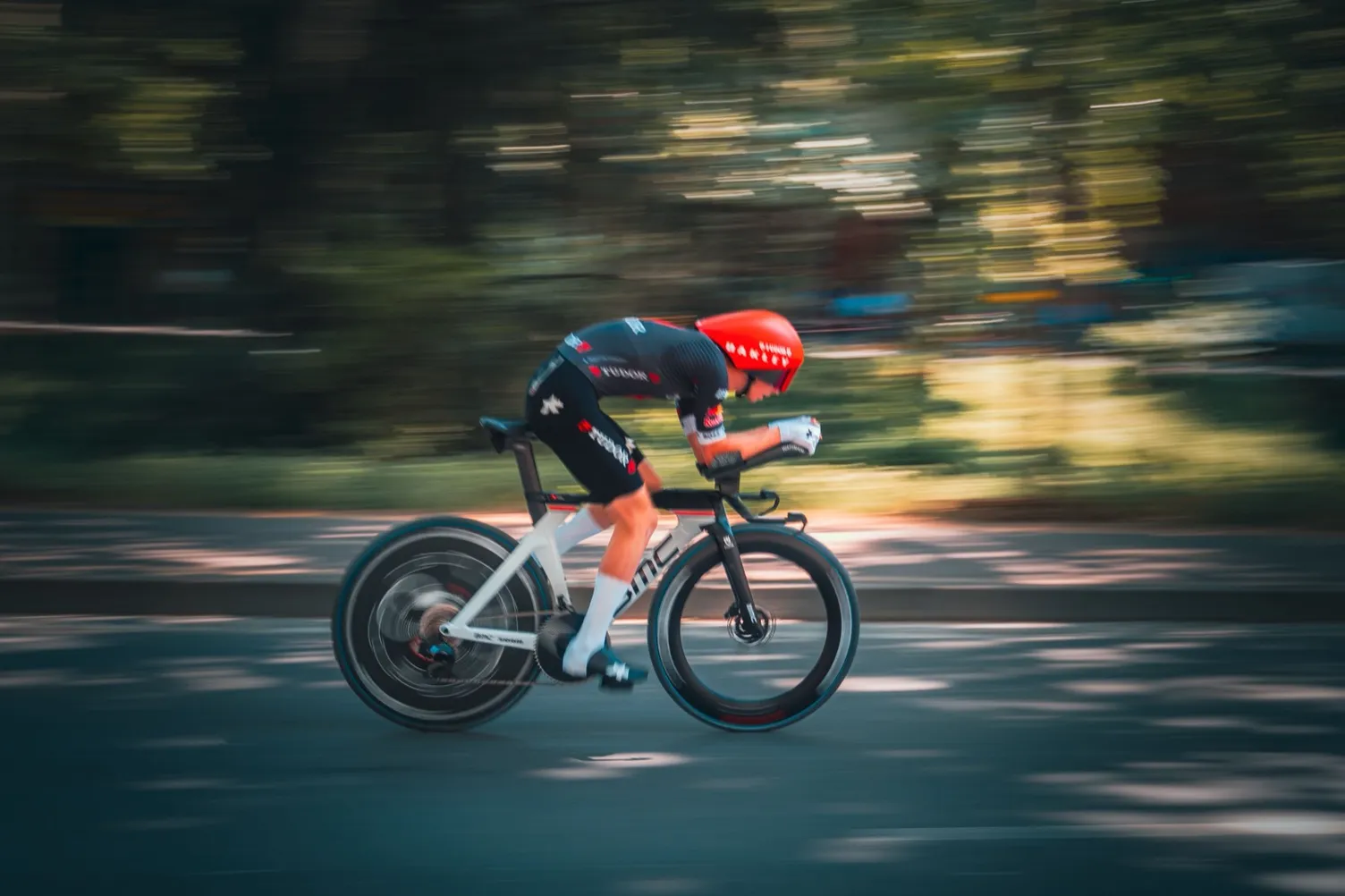
Now flatten the road. Gravity drops out of the equation, and air takes over. Aerodynamic drag force rises with the square of your speed, so the power needed to push through it rises with the cube: double your speed and you need roughly eight times the power (Aerosensor). At race pace on flat ground, aerodynamics swallows the overwhelming majority of your output.
According to aerodynamic-drag analyses of road cycling, at typical time-trial speeds (40+ km/h) roughly 80–90% of a rider’s power is spent overcoming air resistance, with rolling resistance and drivetrain losses making up the small remainder (Best Bike Split, Aerosensor). On the flat, your speed is set by your absolute watts against your aerodynamic drag area (CdA), not by what you weigh.
That last point is the one most weight-obsessed amateurs miss. On the flat, dropping 3 kg does almost nothing; dropping your CdA by tucking into a better position, or simply making more watts, does everything. Weight is the wrong dial. CdA and raw power are the right ones.
Why target weight differs for runners and cyclists
Running and cycling reward different bodies because they obey different aspects of physics. A cyclist can coast, draft, and roll a flat course where weight is nearly free; a runner does none of that. They pay to lift their own mass on every stride, so leanness helps them at every speed and every gradient (J. Appl. Physiol., 2009).
The running number worth memorizing is about 1 kcal per kilogram per kilometer. Studies of running economy put the cost at roughly 1.0–1.1 kcal·kg⁻¹·km⁻¹, and - this is the surprising part - it’s largely independent of pace (J. Appl. Physiol., 2009). Go faster and you burn more per minute but spend fewer minutes, so the per-kilometre cost barely moves. The cost scales with body mass. A 70 kg runner pays for 70 kg, kilometre after kilometre, whether the road is flat or vertical.
That’s the core asymmetry. A cyclist on the flat is fighting air, which doesn’t care much about mass. A runner is always fighting their own body weight, because there’s no coasting and no meaningful aerodynamic shelter at sub-elite speeds. So a runner’s target weight follows one rule everywhere; a cyclist’s depends entirely on what they race.
| Runner | Cyclist | |
|---|---|---|
| Dominant force | Body mass, every stride | Gravity uphill, air on the flat |
| Does weight matter? | Yes, always | Only when climbing |
| Speed-independent cost? | Yes (~1 kcal/kg/km) | No (power need scales with v³) |
| Best lever on the flat | Still leanness & economy | Watts and CdA, not weight |
| Main limiter on leanness | Impact / injury risk | Recovery and power retention |
There’s a hard limit on the running side, though: running is high-impact, and going too light raises stress-fracture and injury risk. The runner’s job is to be light enough to be economical without becoming fragile. The cyclist’s job is to first ask whether weight is even the right conversation.
Step 1: Decide whether weight is even your lever
Before you pick a target weight, decide whether weight is a lever for your events at all. For climbers and runners it usually is. For flat-course cyclists, improving aerodynamics or raw power almost always beats losing weight. And structured training can lift functional threshold power 5–15% in a season with none of the health risk of cutting (TrainerRoad).
Look honestly at your goal events and sort them:
- Mountainous road races, hilly gran fondos, mountain running, vertical races → W/kg or body mass rules. Modest, careful fat loss can pay off directly.
- Flat time trials, criteriums, track, sprints, flat triathlons → absolute power against CdA rules. Spend your effort on position, equipment, and watts; weight loss yields little.
- Rolling or mixed courses → in between. Repeatable power and durability matter more than chasing either extreme.
For a cyclist, how much a kilo is worth depends almost entirely on gradient. On a steep climb it’s a clear, measurable gain. On a pancake-flat time trial it’s nearly nothing. The chart below sketches that relationship: the steeper the road, the more weight costs you.
If your events live on the flat, this is your permission slip to stop dieting and start training your engine and your position instead.
Step 2: Measure your real numbers
A target weight is meaningless without body composition. The scale can’t tell muscle from fat, so you need a body-fat measurement and your lean body mass and you need to know the floors below which performance and health break down: roughly 6% body fat for men and 14% for women (BodySpec).
Why composition and not just weight? Because two athletes at 75 kg can be wildly different engines. One might carry 18% fat and a lot of muscle; the other 10% fat and far less power. The first can lose fat and get faster; the second has little fat to give and would lose muscle (and watts) trying.
Elite endurance athletes typically sit at 6–13% body fat (men) and 14–20% (women), and the floors at the bottom of those bands are not arbitrary (BodySpec). Drop below them and hormones, immunity, and recovery start to fail. And here’s the part most amateurs need to hear: those bands describe full-time athletes with professional support and nine hours of sleep. As a dedicated amateur, your optimum is almost certainly above the elite range. And that’s the correct target for your life, not a compromise.
Step 3: Calculate a target range
Estimate your target weight from lean body mass, not from a chart. Take your current lean mass and divide it by your goal lean-mass percentage. Treat the result as a direction to aim, not a verdict to obey (Fitzgerald).
Here’s the math worked through for a rider at 75 kg and 18% body fat:
- Find lean body mass (LBM). Fat mass is 75 × 0.18 = 13.5 kg, so LBM = 61.5 kg.
- Pick a realistic goal body fat — say 12%, meaning LBM should be 88% of total weight.
- Divide. 61.5 ÷ 0.88 = ~69.9 kg.
That’s a ~5 kg target, every gram of it intended to come from fat while muscle - and power - stays put. Two things make or break it. You need a real body-fat measurement, because scale weight alone tells you nothing about composition. And the goal body-fat figure has to be realistic for you: at or above the floors, and appropriate for an amateur’s recovery. Plug in a pro’s number and you’ll get a pro’s (likely unhealthy) target.
Notice the output is a direction, not a finish line. Your true racing weight is a small band you settle into when training is going well and you’re eating enough to support it, not a number you starve toward. This is also the kind of calculation worth handing to software, because the inputs shift as you train. In Avitu you set a realistic target weight and the app translates it into daily targets, adjusting as your composition and training change.
Step 4: Size the change to your training
Once you have a target, change weight slowly and seasonally. Cap loss at about 0.5 kg per week, do it in your base or off-season, and shrink the deficit as training load rises. A deficit is a stress, and stacking it on a hard training block costs muscle, watts, and recovery (TrainingPeaks).
The single most common mistake is a static deficit. A “500 kcal/day” cut that’s fine in an easy base week becomes dangerous under-fueling in a 15-hour build week. You cannot lose fat and peak for an A-race at the same time, so weight loss belongs where training stress is lowest, and the deficit should taper to zero as your key races approach.
This is the trap that leads to Relative Energy Deficiency in Sport (RED-S), estimated to affect 15–70% of male and 23–80% of female endurance athletes, most often triggered by exactly this pattern: training going up while intake stays flat (PMC, Mayo Clinic). Persistent fatigue, frequent illness, unexplained power loss, disrupted menstruation, poor sleep,… If several sound familiar, stop cutting and get help.
This is the heart of what Avitu does differently. Instead of a fixed deficit, in ‘adaptive mode’, it sizes your surplus or deficit around your actual completed workouts: easing off automatically when load spikes, so you keep losing fat in the easy periods without starving the hard sessions. Finding your target weight is a season-long project, do not approach it as a crash diet. Set a realistic target weight in Avitu and let it size your daily fuel around the training you actually do: pro-grade method, built for everyone.
The bottom line
- Figure out which force you fight before you touch the scale: gravity (uphill) rewards low weight; air (on the flat) rewards watts and a low CdA, not leanness.
- Runners pay for their body mass on every stride at any pace, so leanness helps them everywhere. At least as long as they stay within the limits of impact and injury.
- For flat-course cyclists, training power and improving aerodynamics almost always beat dieting.
- Set a target range from lean body mass, keep body fat above the floors (6% men / 14% women), and aim above the elite bands as an amateur.
- Lose fat slowly (~0.5 kg/week), preferably in the off- or base-season, and size the deficit to your real training load.
Frequently asked questions
Does losing weight make a cyclist faster on flat roads?
Barely. On the flat, roughly 80–90% of your power overcomes air resistance, which scales with the cube of your speed and depends on your aerodynamic drag (CdA), not your mass. Improving position or raising absolute watts beats losing weight (Best Bike Split).
Why does weight matter more for runners than cyclists?
Running costs about 1 kcal per kilogram per kilometre and that cost is largely speed-independent, so every kilo taxes every stride on every gradient. Cyclists can coast, draft, and ride flat courses where air, not mass, dominates, so weight only clearly helps them uphill (J. Appl. Physiol., 2009).
How do I calculate my target weight?
Divide your current lean body mass by your goal lean-mass percentage. A 75 kg athlete at 18% fat has 61.5 kg of lean mass; targeting 12% fat gives 61.5 ÷ 0.88 ≈ 69.9 kg. Use a real body-fat measurement and a realistic goal at or above the health floors (Fitzgerald).
What body-fat percentage is too low?
Below roughly 6% for men and 14% for women, health and performance both decline — hormones, immunity, and recovery suffer. Elite athletes sit at 6–13% (men) and 14–20% (women); as an amateur, aim above those bands (BodySpec).
How fast can I safely lose weight?
No more than about 0.5 kg per week, and only in your base or off-season. Faster loss disproportionately costs muscle, glycogen, and watts, and in-season cuts raise your risk of RED-S and injury when you most need to perform (TrainingPeaks).